Keeping and feeding
Day-to-day care.
Start with a tank of at least 300 litres for one adult, with a sturdy stand and a heavy lid. Use sand or smooth gravel, a few large rocks or pieces of driftwood placed firmly on the bottom, and leave plenty of open space to swim. Live plants are usually dug up, so tie hardy plants to wood or use fake plants. Oscars are messy, so fit a large canister or sump filter and make sure the tank is fully cycled before the fish goes in.
Aim for warm water around 24 to 28 °C that is soft to moderately hard and roughly neutral. Steady conditions matter more than exact numbers. Change 30 to 50 percent of the water every week, vacuum the substrate and rinse filter media in old tank water. Feed a quality cichlid pellet as the staple, sized to the fish's mouth. Add frozen prawns, krill, bloodworm or earthworms a few times a week. Feed juveniles once or twice daily and adults once daily or every second day, and remove leftovers so they do not foul the water.
Behaviour
How it lives.
Oscars are intelligent, curious fish that use the middle and lower levels of the tank, and they often learn to recognise their owner. They do not school and are usually kept alone, as a pair or with a few other large fish. They rearrange decor, dig and can become territorial, especially when pairing or spawning. Anything small enough to fit in their mouth will be eaten, so avoid small fish, shrimp and snails. Suitable tankmates in a big enough tank include other large, robust fish such as Severums, Silver Dollars, Jack Dempseys, Firemouth Cichlids at adult size and large plecos. They suit keepers ready for a large tank and strong filtration rather than first-time beginners.
Tank planning
Set it up well.
Keep them at 24 to 28 °C, pH 6.0 to 7.5 and soft to moderately hard water. Oscars eat a lot and produce a lot of waste, so filtration should be strong, ideally rated for two or more times the tank volume, with moderate flow. Change 30 to 50 percent of the water each week and vacuum the substrate to keep nitrate low. They are sensitive to ammonia and nitrite, and long-term high nitrate and poor water are linked to hole-in-the-head disease. Acclimatise slowly by floating the bag and adding small amounts of tank water over 20 to 30 minutes. A healthy oscar is alert, feeds eagerly and has clear eyes and intact skin. Stress shows as darkened or faded colour, hiding, clamped fins or refusing food. Common mistakes are keeping them in a tank that is too small, overfeeding and under-filtering.
Practical details
Plan the space and routine.
- Origin
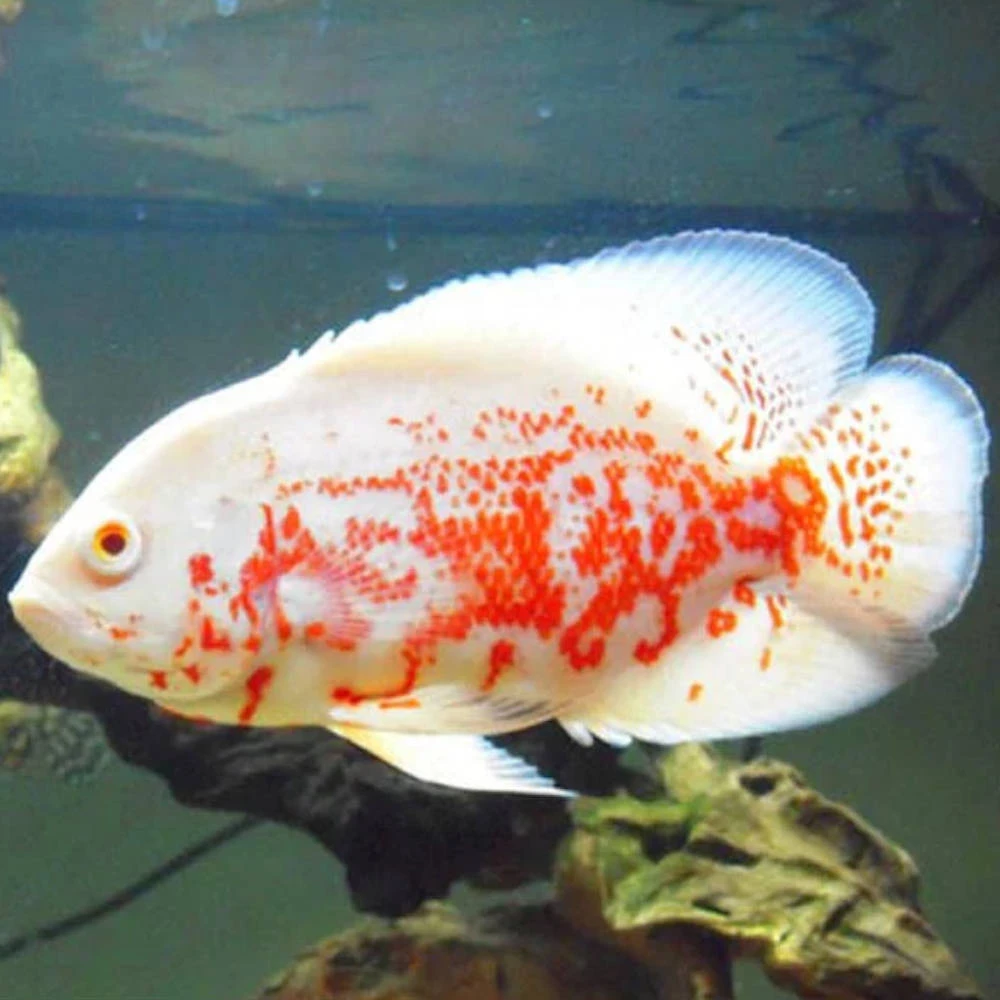
- The Albino Tiger Oscar is a captive-bred colour form of the oscar, Astronotus ocellatus. Wild oscars live in the Amazon basin of South America, in slow-moving rivers, floodplain lakes and flooded forest with soft, warm water. Captive-bred fish are generally hardier and adapt well to a range of neutral, well-filtered water.
- Max Size
- 30 cm
- Diet
- Omnivore. In the wild oscars eat small fish, crustaceans, insects, worms and some plant matter and fruit. A quality cichlid pellet sized to the fish's mouth makes the best staple. You can add frozen prawns, krill, bloodworm and earthworms for variety and condition. Feeder fish carry a disease risk and are best avoided. Feed juveniles small amounts once or twice a day and adults once a day or every second day, only what they finish in a couple of minutes. Overfeeding is the most common mistake: it fouls the water quickly and can lead to bloat and fatty liver problems.
- Tank Recommendation
- One adult oscar needs at least 300 litres, and a tank around 150 cm long and 50 to 60 cm deep from front to back gives it room to turn. A pair or a small group of large tankmates needs 450 litres or more. Use a sand or smooth gravel substrate, a few large, secure rocks or driftwood, and plenty of open swimming space. Oscars dig and pull up plants, so use hardy plants tied to wood, or fake plants. A heavy, tight-fitting lid is a must because they can jump. A 120 L tank is only suitable for a young oscar for a short time.
Tankmates and breeding
Look beyond the first day.
Choose tankmates that are too big to eat and tough enough to hold their own. Good choices in a large tank include Severums, Silver Dollars, Jack Dempseys, larger plecos and other medium to large South American cichlids. Avoid tetras, rasboras, guppies, shrimp and snails, which will be eaten. Very aggressive cichlids and slow, long-finned fish are also poor choices. Add all fish at a similar size where possible, and watch for bullying.
Males and females look very similar and are hard to sex reliably. The only certain sign is the breeding tube that shows at spawning time, which is blunter in females and more pointed in males. The easiest way to get a pair is to raise a group of young oscars together and let a pair form, then rehome the others. Oscars are open substrate spawners. The pair cleans a flat rock and the female lays several hundred to a thousand or more eggs, which both parents guard. The eggs hatch in a few days and the fry swim free about a week later. Feed the fry baby brine shrimp and finely crushed food, and keep the water very clean. Breeding needs a large tank and a well-matched pair.